/media/uploads/2024/04/16/26-the-coin-hoard-from-the-basement.mp3
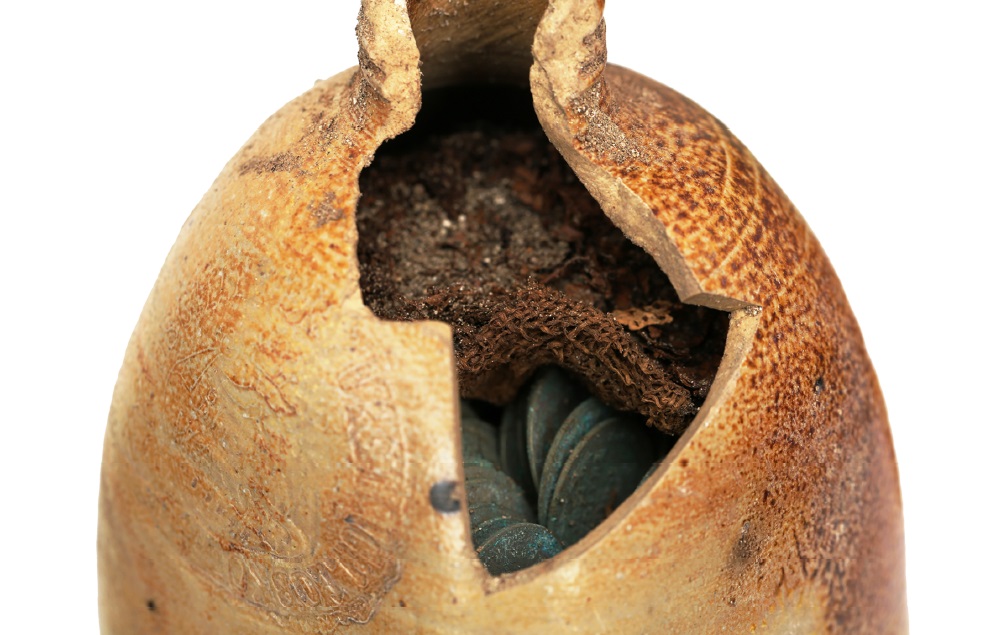
Fortuna Felix - the ancients often said. Luck in archaeology sometimes smiles on the young and inexperienced. This was the case with the two monetary hoards discovered during the restoration of the Hintz House. In 2020 an archaeology student, Katalin Vágó, who was taking part in the preventive archaeological excavations in the basement of the building, discovered a double monetary hoard.
It should not be forgotten, however, that the discovery of a monetary hoard may in fact bear witness to a human tragedy. In this case, the two hoards buried in the cellar of the Hintz Pharmacy contribute to the reconstruction of a lesser-known period in the history of Cluj and to outline the sad story of an anonymous character.
When a monetary hoard is discovered, three fundamental questions arise: in what context was it buried, by whom and why was it hidden. For more distant historical periods, the lack of written records leaves us groping in the dark. But for the 19th century we are luckier. In addition to the official documents of the authorities, local newspapers and magazines tell us in an honest and authentic tone about the life of the town. With the help of these sources, in the case of the Hintz Pharmacy hoard, all three questions could be answered.
In which context?
/media/uploads/2024/04/16/28-in-which-context.mp3
The 972 coins were stored in two ceramic mineral water bottles. The stamp on the body of the jars shows that they were imported from remote areas and sold in the pharmacy. The two bottles come from the north-west of today's Czech Republic, from Karlovy Vary (Carlsbad) and Zaječice, places still famous today for their healing waters.
The largest part of the hoard (927 coins, 95% of the total) is made up of silver coins of 10 and 20 kreutzers, minted in Austro-Hungary between 1868 and 1872. In addition to these common coins, some more valuable pieces were hidden: 17 talers from the 18th-19th centuries and 5 gold coins (florins) from the mid-19th century. The dating of the most recent coins (1872) indicates that the time of hiding should be very close to this year. The hoard was most likely buried in 1873, a year in which Cluj was marked by disturbing events.
On May 9th 1873, the Vienna Stock Exchange collapsed. The date has gone down in history as the first 'Black Friday', as it manifested itself in chain bankruptcies due to speculative investments. The event marked the end of a prosperous period in the Austro-Hungarian Empire and triggered an economic and financial crisis in the Danube monarchy. News of the stock market crash soon reached Transylvania. A few days after the fall of the stock exchange, the Cluj daily Magyar Polgár, which was the main forum of expression of the progressive bourgeoisie, devoted a substantial article to the event on the front page of the newspaper, entitled "The first result of speculation". The article was highly critical of the speculative stock market deals that had spread "like mushrooms" to provincial towns. The author expresses his concern about the possible spread of the crisis to Pest, but also to Transylvania, because "if there is trouble in Vienna, we suffer too".
Who and why?
/media/uploads/2024/04/16/30-who-and-why.mp3
Archaeology and historical reconstruction sometimes resemble a forensic investigation. In order to reconstruct the truth, all the elements must be put in place. One unknown element of the present puzzle is the value of coins in the period and their purchasing power. If we compare the value of the hoard with the prices and wages of the period, one notes that the coins converted into approximately 237.15 florins, which was not a very large sum. In the context of the financial crisis, the amount hidden in the two bottles could cover the expenses of an ordinary townsperson for several months. But the Hintz family was part of the cream of Cluj society. Would a member of the family have needed to bury a relatively modest sum in the cellar of their home? Unlikely. If not, then who could have owned the money?
The cellar of the Hintz house, used as a storeroom for goods, seemed an ideal place to hide money at a time when the banks were perceived as insecure. The owner of the hoard didn't choose the location by chance. He considered the cellar of the pharmacy, with access from both the house and the courtyard, the safest and most accessible place at the same time. The man was convinced that, if necessary, he could always return and recover the coins. All the indications are that the "perpetrator" was working in the building. Thus, the owner of the money, a person with a more modest income (according to the value of the hoard) was most likely an employee of the Hintz pharmacy, possibly a servant who had access to the cellar of the house.
WHY did the Hintz House hoard remain hidden for a century and a half?
The most difficult question with treasures of all historical times concerns the non-recovery of the money. So far we have no clear clues as to what happened to the owner, why he could not get to the hidden money or for what reason he was unwilling/unable to share the secret with anyone. Perhaps he was a man without family, who trusted no one? Possibly. In any case, most likely the cholera epidemic that decimated Cluj in the summer of 1873 is responsible for the non-recovery of the money. A human tragedy, i.e. the sudden illness and death of the owner, seems to be the most credible hypothesis in the case of the hoard in the Hintz pharmacy.