The funeral monument of Domokos Simai Jr., prosecutor of Békés County and judge of several counties, was initially composed of two sections. The upper section was decorated with the sculpture of a winged genius, while the lower section was intended for the funeral inscription. Today, only the figure of the winged genius remains, depicted kneeling with the right arm resting on a funerary urn. In the right hand, it holds a laurel wreath, symbolizing a fulfilled life, and in the left hand, an extinguished inverted torch, symbolizing the passage into nonexistence.
This iconographic type appeared in Transylvania at the beginning of the 19th century and was adopted by a series of Transylvanian funeral monuments, spreading until the end of the fourth decade of this century. In contrast to the dramatic language of the Baroque, dominated by the frightening idea of death, these early neoclassical monuments present a new vision of death, perceived as eternal, peaceful sleep. They do this through the representation of dreaming geniuses, complemented by a series of other elements symbolizing the passage of time.
Domokos Simai Jr.'s funeral monument falls into the category of late neoclassical monuments. Its formal quality is inferior to earlier analogies, but its importance lies in the fact that it is one of the testimonies of an interesting phenomenon in the city's history. This phenomenon is the establishment and development of a strong layer of Armenian merchants at the end of the 18th century and the beginning of the next century, who over time established close ties with the city's Minorite church.
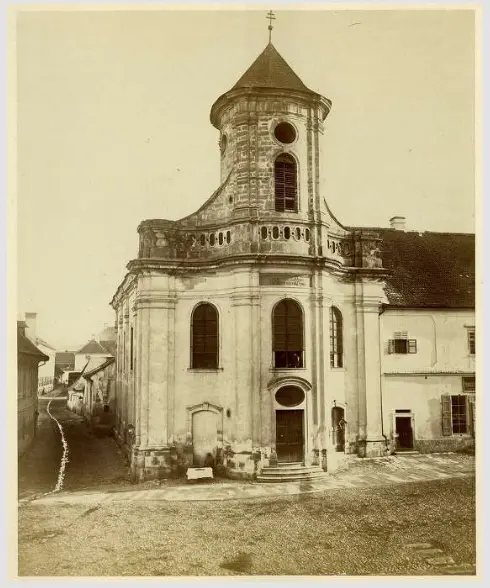
Main facade of the Minorite Church in 1869, photograph by Ferenc Veress.